There are little men inside my head that tell me what to do.
No.
Really.
Here’s one of them:

The little man is a model according to a sketch of the human body on the surface of our brain.
The different parts are sized according to how much space the brain gives to processing information about that part of the body. This particular model – called the sensory homunuculus because it is constructed based on the sensory cortex – is where sensory signals from the body converge. The sensory cortex is a physical map of the body on the surface of the skin, also called the ‘somatosensory’ cortex (mean ‘body sensing’). Each part of your body has a different position on the surface of the map, and mostly, but not always, bits of the body that are next to each other are processed next to each other in the cortex.
There are similar maps in both sensory cortex and in motor cortex (where motor plans – and even the perception of other people’s movements – convert before becoming actions). They are not completely identical – one of the applications discussed in the book lets you compare the differences between the two – but one similarity is that the major breaks in the continuity of the map are the same. The hand areas are next to the face areas, and the foot areas are next to the genitals area.
You can mostly see this from this image of the motor cortex (which i took from PBS- thanks PBS!)
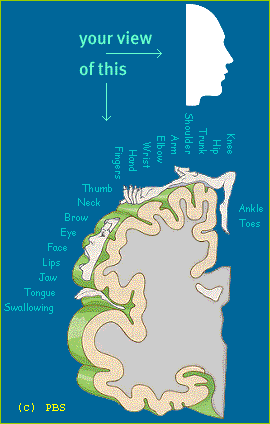
Rather that appearing on the map near the hip, the genitals appear below the toes, in the crevice at the top of the brain (rather prudishly the genitals are not shown on this image, which isn’t uncommon). The fact that the genitals are next to feet are responsible for the ‘whole leg orgasm’ phenomenon in amputees (which the neuroscientist VS Ramachandran talks about here. Following injury to the body the brain’s maps can reorganise – unused areas becoming canibalised to help with processing of areas which are still being using. VS reports of leg amputees whose somatosensory cortex had reorganised to devote the areas previously used to represent the leg to processing the sensory input from the genitals. When the patients had sex they had an orgasm – but with two or three times the amount of brain space devoted to representing the feeling!
Wow.
Anyway, this is a bit of distraction from the thing I wanted to talk about in this post: why are there breaks in the map of the body as it appears on the surface of the cortex?
Martha J. Farah of the University of Pennsylvania wrote a paper [1] which gives one suggestion: the maps are like that not because they are innately fixed that way, but because they self-organise that way as brain develops in the womb. We know that a lot of the structure of the brain isn’t entirely pre-specified, but arises due to what activity happens during development. It’s called activity dependent development, and similar processes are responsible for the re-wiring the happens during adult learning. Martha Farah suggest that, because of the way a baby is tucked up in the womb – with the hands curled up near the face and the feet tucked in by the genitals – these two pairs of locations are most likely to be co-activated by any movement experienced by the baby. And it is this activation – and co-activation – by random movements that is used to seed the structure of the sensory map.
Neat, eh?
This goes to explaining the organisation of the sensory map, and perhaps the motor map is based on the initial template of the sensory map and so develops that way – an initial bias towards the face-hands, feet-genitals discontinuity becoming locked in during the process of map self-organisation.
A couple of points Prof. Farah doesn’t make are:
Firstly, the four areas mentioned in the title of the paper are the four with the largest representational resources dedicated to them. Surely it is not coincidence that the four areas where the map continuity is broken are the four most important areas?
Secondly, the standard diagram shows the cortical map as being, effectively, 1 dimensional (ie an ordered scale of areas). Is there a reason for this (perhaps due to the four aforementioned regions requiring so much representation that they require the whole width of somatosensory cortex, preventing proper 2 dimensional representation of the body)? When mapping a 3D body to a 1D map discontinuities would have to occur, wouldn’t they? So the existence of discontinuities itself isn’t at all surprising, but the self-organisation of representational maps suggests why they are where they are.
Refs
1. Farah, M.J. (1998). Why Does the Somatosensory Homunculus Have Hand Next to Face and Feet Next to Genitals?: An Hypothesis. Neural Computation, 10 (8), 1983-1985.


The first picture you link to is from the Natural History Museum not the ‘National’ History Museum. As a former employee of the place I know it *really* annoys them when people get it wrong.
Very sorry – it was a late night editing haze mistake – I’ve corrected it now. Thanks for pointing it out
Links again
It’s been a busy few days, almost no time to blog… so here are some links, with minimal commentary: I’m sure it’s the lack of sleep that’s made me gain weight since I started my current job. Nothing to do…
Random Links from Email
Star Wars car. Buy feces now (vacuum-wrapped). This place is for bikes (video). How various artists work; check out Umberto Eco’s, in particular (this one via Boing Boing). Add more in the comments, please. UPDATE: Our minds are physical (via…
Another batch of links
[via Fark, of course] ‚Ä¢ Wonkette had the best line after Rumsfeld flubbed that question from an enlisted about ‚ÄúWhere the hell are our armored vehicles?!‚Äù: ‚ÄúYou have to dig through the landfills,‚Äù Rumsfeld replied, ‚Äúbecause we’re conduc…
Ducks, Gills, Syphilis, and the Homunculus: The Tangled Bank # 18
Ducks, Gills, Syphilis, and the Homunculus — what do they have in common? The Tangled Bank! It is our pleasure to have you at The Tangled Bank, the biweekly sampler of science, medicine, and natural history blogs. Put on
E se nosso corpo fosse proporcional ao nosso cérebro?
Como seria o corpo humano fosse proporcional ao espaço que o cérebro usa para processar suas informações sensorias?
Estudos sobre o cérebro permitiram identificar as áreas do cérebro utilizadas no processamento de cada sensação sensoria
E se nosso corpo fosse proporcional ao nosso cérebro?
Como seria se o corpo humano fosse proporcional ao espaço que o cérebro usa para processar suas informações sensorias?
Estudos recentes permitiram identificar as áreas do cérebro utilizadas no processamento de cada informação sensorial.
Just wondering where on earth I can get hold of a replica of the sensory homunculus model – tried the museum itself and have looked all over but nothing doing? Any ideas?
Warmest regards
No idea, but if you find out please let me know!