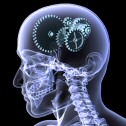
 Jonah Lehrer, author of Proust was a Neuroscientist, is a guest on this week’s All in the Mind, where he discusses why he thinks the arts are an essential complement to the sciences in the attempt to understand human experience.
Lehrer argues that some artists aim to explore, capture or communicate aspects of our subjective experience that are otherwise indefinable.
Perhaps most controversially, he suggests that through these explorations some artists have glimpsed the functional organisation of the brain – even though we’ve only come to realise this in more recent lab work.
Nevertheless, Lehrer argues that art is more than just a reconnaissance mission for science.
Although some of its ‘discoveries’ can stimulate research or be validated by experiments, it also communicates what science cannot, and so is essential as part of the wider attempt to understand ourselves.
It struck me while listening to the programme that Lehrer talks about art in the same way many clinical scientists talk about working with patients.
In neuropsychology and neuropsychiatry particularly, clinicians will constantly be trying to integrate the empirical research and objective medical tests with the patient’s subjective account of their experience.
The patient’s narrative (soliloquy perhaps?) also helps direct a scientific approach to their individual problems, and raises broader scientific questions about the course of the disorder or the function of the normal system, now gone awry.
While clinicians are trained to draw these reflections from their patients with careful questioning, artists are like evangelists for the subjective – making their first-person experience available to all.
Moreover, these experiences often come in such fine and exquisite detail that not even the most skilled clinician could provoke such insights.
Link to AITM with Jonah Lehrer.


Dostoevsky was epileptic; he wrote most of Crime and Punishment in the aftermath of a seizure. I’m hydrocephalic, I learned to read when I was 3 and I’ve always had excellent written and oral communication skills. It’s been documented that many people in the creative arts community have some form of mental/psychological/seizure disorder. It’s therefore no surprise to me that “Lehrer…thinks the arts are an essential complement to the sciences in the attempt to understand human experience.”
I wanted to be an artist… I decided to become a scientist because a side of my psyche I am afraid of manifests during periods of prolific art production.