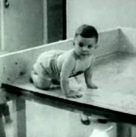
 Vimeo has some video of what looks like footage from Gibson and Walk’s original 1960 ‘visual cliff’ experiment where they tested whether infants had depth perception by attempting to get them to walk over glass plates suspended above a drop.
Unfortunately, the video doesn’t fully describe the experiment, which is a pity as it was a fantastic idea.
The researchers wanted to find out whether 6 to 14 month-old infants could perceive depth. Babies are not the best conversationalists, but they do have a natural sense of danger, so the experiment is based on the idea that the babies will avoid perceived danger, even if it’s completely safe.
The study put the infants, one at a time, in the middle of a table, with one side replaced by glass so you could see the ‘drop’.
Their mothers would try and tempt them over both sides, and if the kids had no depth perception, the glass ‘drop’ wouldn’t seem scary and they’d just walk straight over. Those who could see the ‘drop’ would avoid it.
Pretty much none of the infants wanted to walk across the ‘visual cliff’, suggesting that even kids of 6 months old could perceive depth.
Children younger than that generally can’t crawl though, so it makes it a bit harder finding out at what age depth perception develops.
In 1973, a study by psychologist Andrew Schwartz placed five and nine-month olds on each side of the ‘visual cliff’ and measured their heart rate.
When placed over the glass ‘drop’, the five month olds typically showed no increase in heart rate, suggesting there was no danger response. This suggests depth perception probably kicks in between about five and six months old.
More recent research has shown it’s a more complex picture than this, as depth perception has many parts which don’t all seem to develop at the same rate, but the ‘visual cliff’ experiment is still widely used in psychology.
Link to video of ‘visual cliff’ experiment.
Link to text of original study.
 Mind Hacks
Any person teaching this subject should examine the work of Witherington and Campos. I attended the 2006 International Conference on Infant Studies in Kyoto. The presidential address (by Dr. Campos) proposes that the visual cliff is really tapping into something different from depth perception. While reviewing file footage, they noticed that even the youngest infants would brace themselves before touching the shallow end (suggesting they already HAVE depth perception). The researchers searched for another explanation and found it in locomotion. The infants with the most profound aversion to the cliff were those with the most experience walking/crawling. What they believe is really happening is that the infant is learning to associate the physical environment with the visual environment. Crossing the glass just doesn’t “add up,” the body expects to fall, and when it does not, the body feels unusual. The phenomenon known as proprioception is in effect here. To test the hypothesis, they used a moving room paradigm, and sure enough, pre-walking infants were unfazed by the room, but children with experience walking/crawling moved with the room (forcing the physical and visual to coincide). To see more, please read their 2005 article entitled “Avoidance of heights on the visual cliff in newly walking infants.” God I love psychology! (Grad student in experimental psych)