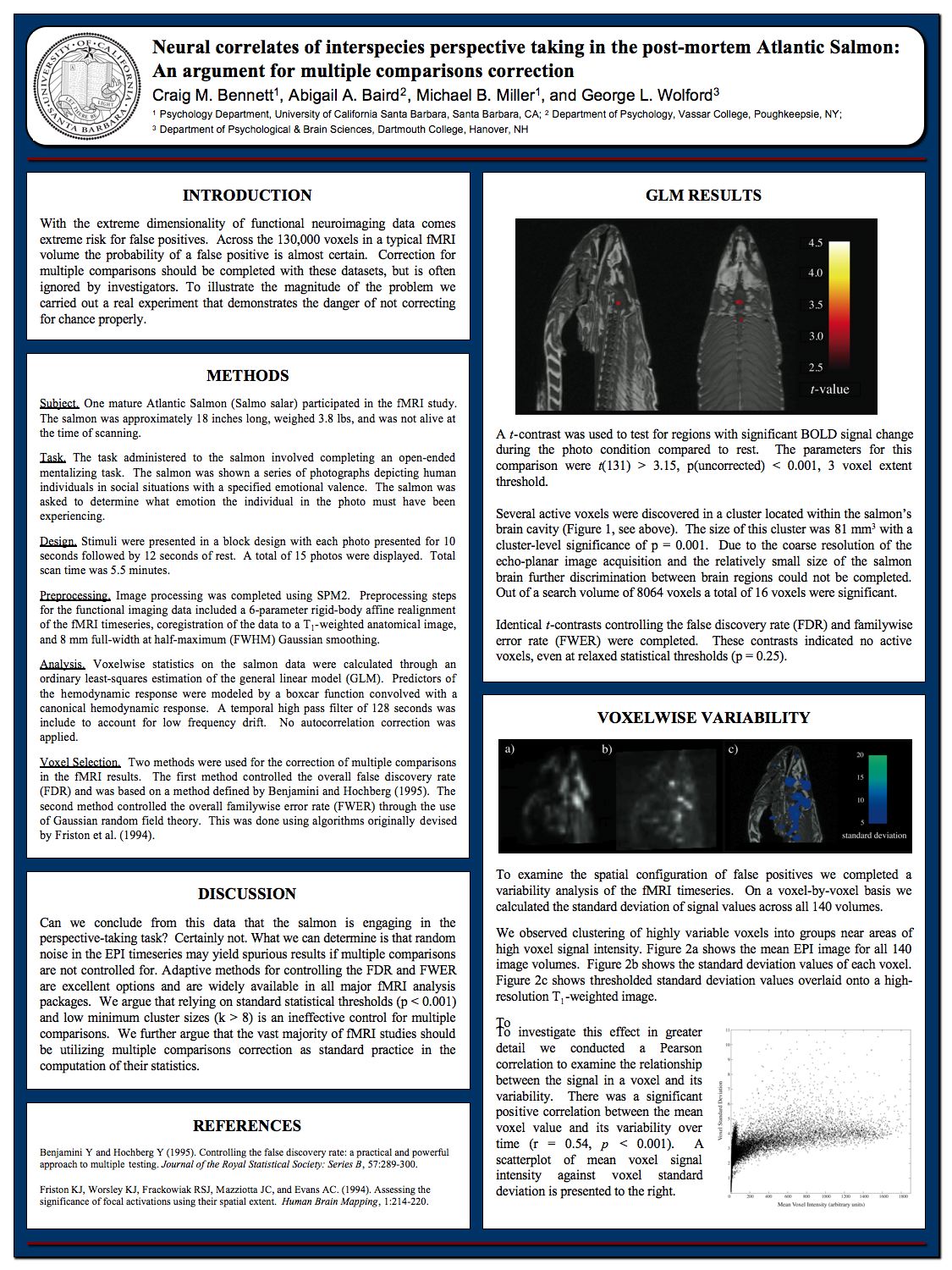
 Neuroskeptic covers a hilarious new study that involved brain scanning a dead salmon and finding activation in the brain as it ‘looked’ at photos of human faces.
The authors are not genuinely arguing that dead fish have brain activity but have run the experiment to show that some common statistical methods used in fMRI research will give false positives if they’re not adequately controlled for.
The research, led by neuroscientist Craig Bennett, was presented as a poster at a recent conference and has the brilliant title of “Neural correlates of interspecies perspective taking in the post-mortem Atlantic Salmon: An argument for multiple comparisons correction” and is available online as a jpg.
I’d say that this research was justified on comedic grounds alone, but they were also making an important scientific point. The (fish-)bone of contention here is multiple comparisons correction. The “multiple comparisons problem” is simply the fact that if you do a lot of different statistical tests, some of them will, just by chance, give interesting results.
Most statistics used in psychology, and indeed brain imaging, are based on calculating a p value.
Usually, a p value of less than 0.05 is considered significant and this means that if there was genuinely no difference in the things you were comparing, you would get a false positive less than 5% of the time.
But your average fMRI brain scan analysis can involve 40,000 comparisons, so even if there’s nothing going on, some bits of the brain are going to seem active just through falsely detecting noise and measurement error as real effect.
To help prevent this, you can correct for multiple comparisons by reducing the 5% cut-off to a smaller amount. Unfortunately, some of the standard methods of doing this can be so strict as to create false negatives, when genuine differences are dismissed as statistical noise.
There is no hard and fast rule about which methods to use, but our salmon neuroscientists have graphically illustrated how misleading results can occur if we naively assume that not correcting accounting ‘multiple comparisons problem’ will give us an accurate picture of brain function.
Kudos to the Neuroskeptic blog for picking up on this and for some excellent coverage of this study.
Link to Neuroskeptic on dead salmon study.
jpg of conference poster.


Hahahaha: “The salmon was asked to determine”
How I would have loved to be in that room.
Great report!